
There’s a reason Gingham has never really gone away. While other patterns drift in and out of fashion, the check endures — in part because it’s so fundamentally architectural. It’s a grid. It has structure, rhythm, and balance baked into it. And when you scale it up, something interesting happens: it stops being quaint and starts being bold.

Bedroom designed by Salvesen Graham
I’m talking about large-scale checks here. The generous, graphic checks that hold their own across a room — jumbo gingham, buffalo checks, oversized tartans, bold two-tone grids. These are the checks that make a statement without making a fuss.
Here’s how I use them.
1. Start with upholstery
A large checked armchair or dining chair becomes an instant anchor in a room. It reads bold and confident without being overpowering, and it works equally well in formal and relaxed spaces. There’s something about a checked chair that feels both classic and slightly unexpected — it signals that someone has made a deliberate choice, rather than defaulting to plain.
2. Go big to make a statement
Large-scale checks bring warmth, rhythm, and a sense of groundedness that smaller patterns simply can’t match. They feel generous and intentional — never fussy. Where a small check can read as safe or predictable, a large check has presence. It fills a room with energy without competing with everything else in it.
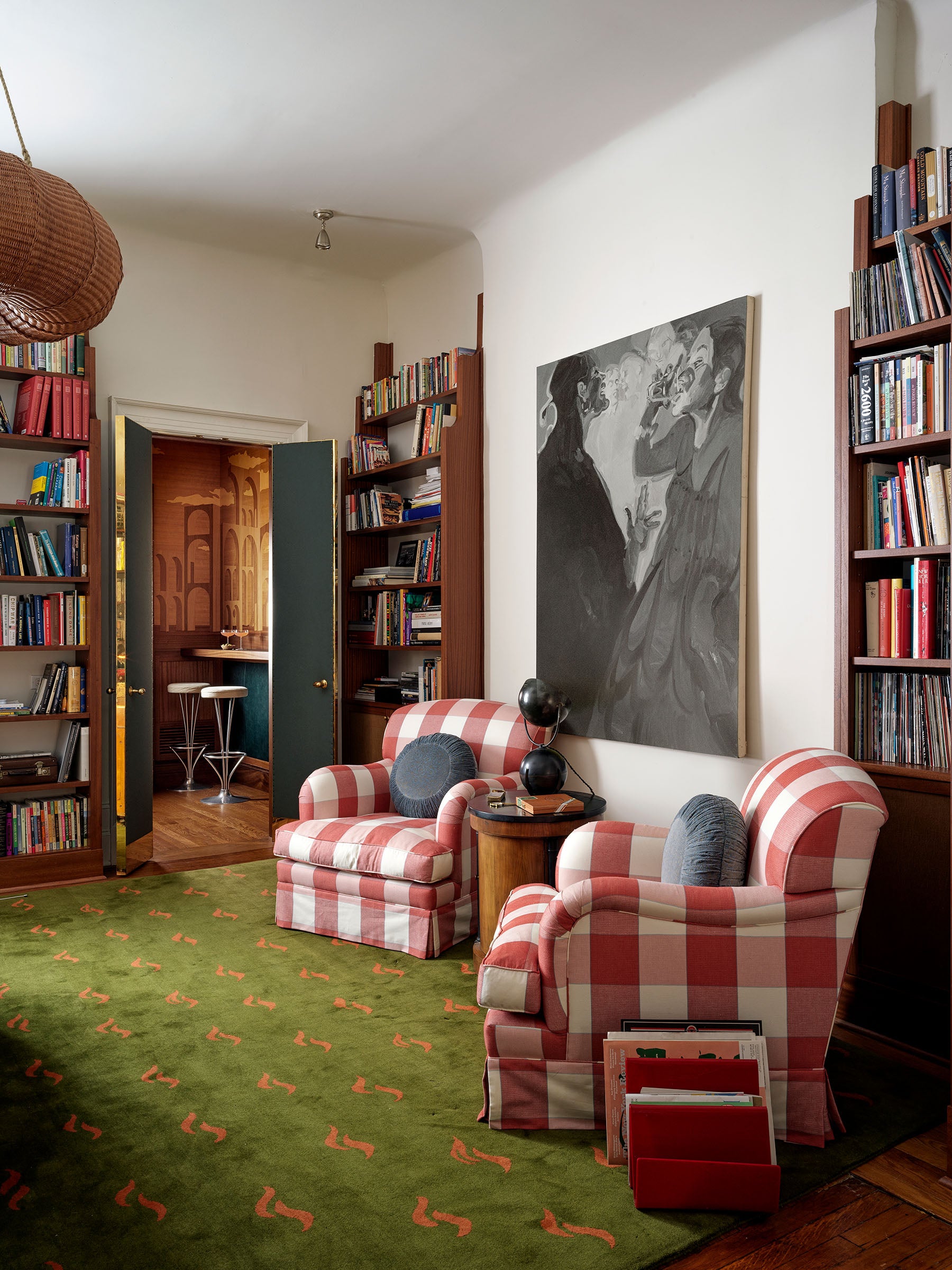
Room designed by Beata Heuman
3. Layer it with solids, texture — and bolder patterns
This is where the magic happens. Large checked cushions against a linen sofa. A bold checked throw over a leather club chair. A checked ottoman in a room full of plain upholstery. The pattern sings loudest when it has something quiet to play off.
But don’t be afraid to push further. A large check paired with a glazed chintz is one of my favourite combinations — the structured geometry of the check against the lush, painterly quality of chintz creates a tension that makes a room feel truly layered and collected. The same goes for paisley: its flowing, organic curves are the perfect counterpoint to the rigid grid of a check. These aren’t obvious partners, which is exactly why they work. The contrast between the disciplined and the decorative gives a room real depth.
4. Don’t overlook walls — or joinery
A large-scale checked wallpaper adds structure and drama in a way that few other patterns can. It transforms powder rooms, mudrooms, and reading nooks into spaces with real presence. I particularly love it in small rooms where you can commit fully — floor to ceiling — without it overwhelming.
And here’s one most people don’t think of: checks in joinery. Using contrasting tones of timber — or alternating painted and natural wood — to create a checked or grid pattern on cabinetry, panelling, or built-in shelving is a beautifully subtle way to introduce the pattern architecturally. It doesn’t shout. It’s discovered. You notice it the second or third time you’re in the room, and it gives the space a crafted, bespoke quality that wallpaper or fabric alone can’t achieve.
5. Mix checks with other patterns
Large checks love company — you just need to know how to introduce them. Pair a bold check with stripes for a tailored, collected feel that reads almost menswear-inspired. Or soften it with florals for something more layered and romantic. The key is keeping your colour palette cohesive. When the tones talk to each other, even confident pattern combinations feel effortless rather than chaotic. If your check has olive and cream, make sure your floral or stripe picks up at least one of those tones.
If this feels like a lot, start with a single checked cushion in a room you already like. Live with it for a week. You’ll be surprised how quickly the room starts to feel more interesting — and how quickly you want more.
RELATED RESOURCES
→ Read more on pattern mixing: Go on mix up your Patterns! Here’s how.
→ Want help planning your scheme? A 30-minute consultation can do just that. Book here.